

We value your privacy
We use cookies to enhance your browsing experience, serve personalized ads or content, and analyze our traffic. By clicking "Accept All", you consent to our use of cookies.
We use cookies to improve your experience.
Your first ten minutes on an Indian road will rewrite everything you thought you knew about traffic.
A bus overtakes a truck that is overtaking a tractor. A cow stands in the middle of a roundabout, calm and unbothered, like a traffic officer who has decided to take the day off. A family of four rides past on one scooter, and the youngest is fast asleep. Every horn in the city seems to be talking at once. And somehow, unbelievably, it all works.
That's the first lesson of India: there are rules everywhere. They just aren't always the ones written down. Once you understand the unwritten norms, both on the road and off it, India stops feeling chaotic and starts feeling like a living, breathing dance. And you're invited to join in.
This guide is the cheat sheet we give our own guests before their motorcycle tour in India. Read it once, and you'll ride, eat, greet and explore like someone who has been here before.
At home, using your horn usually means "you idiot". In India, it means "Hello, I'm here, just so you know." Honking is how drivers tell each other where they are, especially on blind mountain corners and when overtaking. Many trucks even have "Horn OK Please" painted proudly across the back, an open invitation to let them know you are about to pass.
Do: Give a short, friendly tap of the horn before overtaking, on blind bends and when approaching people or animals on the road. Don't: Take a horn personally. Nobody is angry with you. They are simply saying hello.
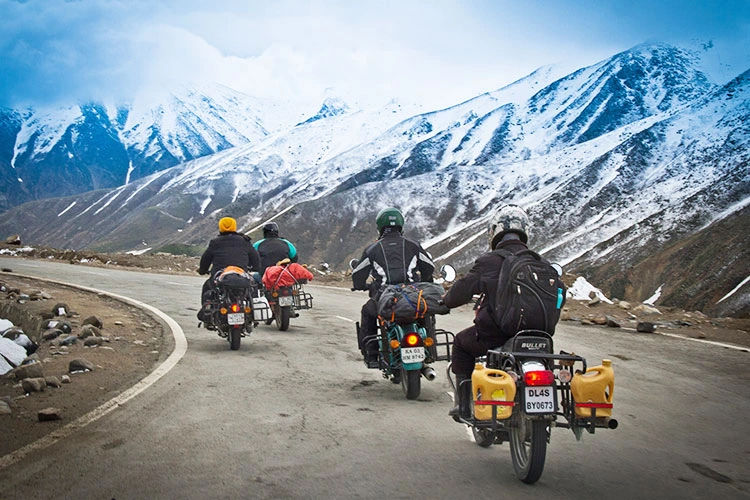
Officially, India drives on the left. Unofficially, the right of way often belongs to whoever is biggest. Trucks and buses come first, then cars, then motorcycles, then bicycles and people on foot. As a rider, the smart approach is simple: be visible, be predictable and never assume a larger vehicle has seen you.
On a guided tour this becomes much easier. Your lead rider sets a safe pace and line, and a sweep rider stays at the back of the group, so you can focus on reading the road rather than finding your way.
In India, the road is shared with everyone, and some of the "everyone" has four legs. Cows are sacred to many Hindus, and they know it. They will stand, sit and sleep wherever they please. In the mountains you'll meet herds of goats and sheep being moved by shepherds; in Ladakh, the odd yak; in Rajasthan, perhaps a camel cart.
Do: Slow right down, give animals plenty of space and pass gently. Don't: Rev your engine at livestock or try to squeeze through a herd. Patience always wins. A shepherd will usually clear a path for you with a smile and a wave.
A flashing headlight coming toward you usually means "I'm coming through, don't pull out", not "go ahead". On narrow mountain roads, traffic going uphill traditionally has the right of way, and drivers often pull into wider spots to let others pass. Your guide will explain hand signals and the group's riding formation during the briefing on day one.
Indian roads can change in a moment, from beautiful new tarmac to gravel, potholes, speed bumps with no warning paint, or a sudden water crossing in the mountains. The golden rule: ride at a speed that lets you stop within the distance you can see. On tour, local drivers and your team check road and pass conditions every morning before you leave, so the day's plan always fits the reality. Our motorcycle travel guide to India covers road conditions region by region.
You may be stopped at police or army checkpoints, especially in the Himalaya. This is completely routine. Keep your passport, home motorcycle licence and International Driving Permit within easy reach, take off your helmet, smile and let your tour leader handle the conversation. It is usually over in minutes.
Press your palms together at chest level, give a slight nod and say "Namaste". It works with everyone, everywhere, and it will always be received with a smile. In Ladakh and Zanskar, switch to "Julley!", a single cheerful word that means hello, thank you and goodbye all at once.
Handshakes are common between men in cities and business settings. With women, it's best to wait and follow their lead. Many will prefer a namaste.
Sooner or later someone will answer your question with a gentle side-to-side tilt of the head. It's not a no. It's not quite a yes either. The Indian head wobble can mean "yes", "OK", "I understand" or "sure, why not", depending on context. You'll be doing it yourself by the end of the trip, and your friends back home will notice.
In India, the left hand is traditionally associated with hygiene tasks. So eat, pass food, hand over money and give gifts with your right hand, or with both hands as a sign of respect. Don't worry about making a mistake; people are very forgiving of visitors. But using your right hand shows you've made an effort, and that is noticed.
Feet are considered the lowest part of the body, so avoid pointing your feet at people, religious images or altars, and don't step over someone sitting on the floor. If you accidentally touch someone with your foot, a quick touch of your hand to their arm and then your own chest is a lovely, polite apology. The head is considered sacred, so avoid patting anyone on the head, including children.
India is a country of 1.4 billion people, and personal space is a little smaller here. Queues can feel more like crowds. People may stand close, stare with friendly curiosity at your big motorcycle and gear, or ask questions that feel personal: "Which country? Are you married? How much does your bike cost?" This isn't rude here. It's genuine interest. A smile and a simple answer will often lead to a great conversation and, quite possibly, a selfie request.
India is home to many faiths, and on a tour you might visit Hindu temples in Rajasthan, Buddhist monasteries in Ladakh, Sikh gurdwaras, mosques and churches, sometimes all in the same week. The rules are simple and similar everywhere:
If temples and culture are a highlight for you, our cultural tour packages in India pair beautifully with a ride.
Indian food is a highlight of any trip, and on tour you'll eat everything from thali in Rajasthan to momos and butter tea in the Himalaya. Many Indians eat with their right hand, using roti or naan to scoop up curries. You are welcome to try it, and nobody will mind if you ask for a spoon.
Do: Drink bottled or filtered water, eat freshly cooked hot food and wash or sanitise your hands before meals. Don't: Drink tap water, and be careful with raw salads and ice in places you don't know. On our tours, water is provided and restaurants are chosen for hygiene, which takes most of the worry away.
India has one of the highest proportions of vegetarians in the world, and in some holy towns meat and alcohol aren't served at all. Vegetarian and vegan travellers will be in heaven. If you have allergies or dietary needs, tell us before the tour so we can arrange it with hotels in advance.
Alcohol is available in most of India, but attitudes are more conservative than in many Western countries, and some states (such as Gujarat and Bihar) are officially dry. Drinking in public places is frowned on. Most importantly, there is zero tolerance for drinking and riding on our tours. Save the cold beer for the evening, once the bikes are parked.
If you're invited for tea, especially in a village home, try to accept. Refusing hospitality can seem impolite, and a cup of sweet, spiced masala chai with a local family is often the memory people treasure most. It's polite to accept at least a small amount, even if you've just eaten.
India is generally conservative in dress, especially outside big cities. For both men and women, loose clothes covering the shoulders and knees are the safest and most comfortable choice. Light cotton is perfect for Rajasthan and South India; warm layers are essential in the Himalaya. Swimwear belongs at the beach or the hotel pool only. Public displays of affection, beyond holding hands, are best kept private.
India is one of the most photogenic countries on Earth, and many people will happily pose for you. But always ask first, especially with women, older people and religious figures. A smile and a gesture toward your camera usually works. Never photograph military sites, airports, bridges or checkpoints. In border areas like Ladakh this is taken very seriously.
Bargaining is normal in markets and with street sellers, but not in shops with fixed prices, restaurants or hotels. Keep it friendly. It's a conversation, not a battle.
Tipping is appreciated. In restaurants, around 10% is common if service isn't already included. Most riders also give a tip to their support crew (mechanic, support vehicle driver and guides) at the end of the tour, and it is always deeply appreciated.
Cash and cards: India has become very digital, with mobile payments everywhere, but foreign cards don't always work with local apps. Carry some cash in small notes, especially in remote mountain areas where ATMs may be rare or empty.
Finally, the most important norm of all: patience.
In India, plans can change. A mountain pass may close for snow, a festival may fill a town's streets, or a herd of goats may hold you up for twenty minutes. The phrase you'll hear most often is "no problem", and that attitude is the secret to enjoying this country. The riders who have the best time aren't the fastest or the most experienced. They're the ones who smile when things change and see the delay as part of the story.
The good news is that on a well-run guided tour, it's not your job to solve those problems. That's what your team is for. Your job is to ride, look around and say yes to the cup of chai.
|
Do |
Don't |
|
Tap your horn before overtaking and on blind bends |
Take honking personally |
|
Give animals plenty of space |
Rev at livestock or squeeze through herds |
|
Greet with "Namaste" (or "Julley" in Ladakh) |
Pat people on the head |
|
Use your right hand for food and money |
Point your feet at people or shrines |
|
Remove shoes and cover up at holy places |
Photograph people or military sites without permission |
|
Accept tea and hospitality |
Drink tap water |
|
Carry licence, IDP and passport |
Drink and ride, ever |
|
Stay patient and flexible |
Expect everything to run on time |
Etiquette is easy to learn, and the fastest way to learn it is to travel with people who live it every day. On a guided Royal Enfield tour with Brahmand, your English-speaking tour leader will guide you through every temple visit, roadside chai stop and police check, so you're never left guessing.
If you're dreaming of palaces and desert forts, start with our Rajasthan motorcycle tours, perfect for a first taste of riding in India. Want to prepare even more? Our India travel guide covers visas, money, health and more.
Ready to choose your dates? Check the 2027 motorcycle tour calendar, or contact our team with any question at all. We promise: no question about India is too small.
Namaste, and see you on the road.