We value your privacy
We use cookies to enhance your browsing experience, serve personalized ads or content, and analyze our traffic. By clicking "Accept All", you consent to our use of cookies.
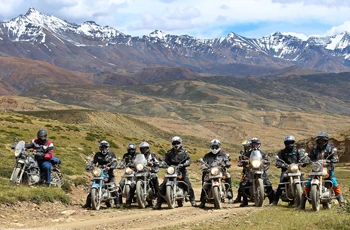
Touring India and choosing to ride a bike has a certain allure. The long, winding roads with lush, green fields and the Himalayas in the distance. The temples, the wildlife, the culture, the people. It’s all there, right on your doorstep. But most see touring India by bike as an extreme challenge. The images of chaotic roads where the rules are more like suggestions. Where massive semis blindly barreling around a curve, swerve to pass you on the right. Where the roads are utterly without markings. All while stray cattle wander aimlessly. And you thought Mumbai had bad traffic? After you ride a bike through India, you will agree that it isn’t that bad. It really isn’t that different from riding back home.
Of course, the right equipment, the right bike or e-bike, the right route and insurance will have you covered. This guide will assist you in your preparations.
To ride a motorcycle in India you will require the following documents:
A valid passport and Indian visa.
Insurance: Travel and medical insurance that covers cycling, and offers coverage for altitude. Most general travel insurance exclude coverage for adventure sports and activities beyond 3,000 - 4,000 meters.
A copy of the permits issued by the Indian authorities for restricted areas. For more information, see the Protected Area Permit section.
It is always recommended to have printed copies of your insurance, emergency contact information and other important documents as there may be no network/ signal in some locations.
You will not need a third party insurance for a bicycle or e-cycle. However, you will need the following:
Cycling activity will be covered under travel insurance. General travel insurance have exclusions and/or coverage limits for cycling activities and/or touring.
Coverage for altitude: If your itinerary is at an altitude of more than 3,000 meters. Most general travel insurance will not cover air ambulance in such cases.
Some travel insurance policies will cover your bicycle or e-cycle if you transport them to the loss or damage location.
Insurance is available for purchase prior to landing. Insurance sold at the airport will not cover motorcycling mishaps or altitude sickness, and will not cover incidents that happen prior to the policy’s effective date.
It is important to understand Indian traffic culture. Unlike the U.S., larger vehicles will take precedence over smaller vehicles. A beep from a horn will notify a smaller vehicle that a larger vehicle is in front of it. Traffic will seem chaotic at first but it is actually completely organized. It is best to give yourself 3 to 4 days to fully understand how to navigate traffic as a right hand drive vehicle driver. You will also have to become accustomed to driving on the left side of the road. Pedestrians and other road users will not give you right of way, and will attempt to merge in front of you. You must always be on guard and anticipate that all other road users will completely disregard your presence.
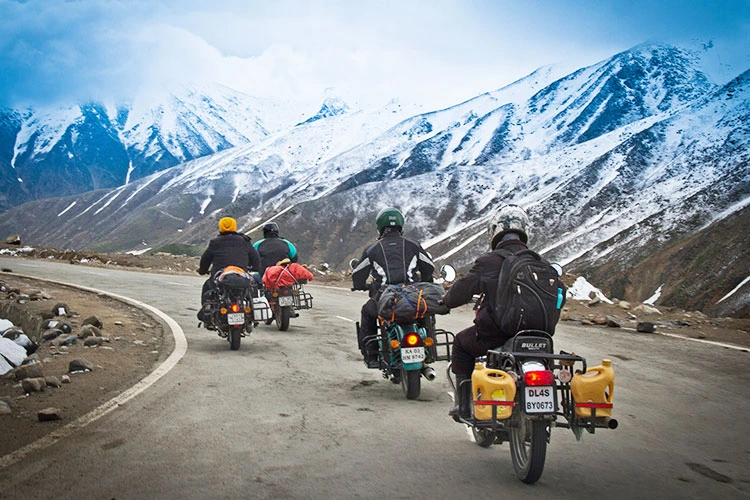
Riders can be caught off guard by the condition of roads in new, and sometimes even developing, countries. Those riding out of Manali, a town in India famous for its access to mountain roads, can find themselves on smooth, new roads and then, in a matter of hours, be riding on a road that contains numerous landslide scars and no recognizable pavement. The roads in India can be particularly challenging as they can take riders a long time to traverse due to numerous changes in elevation and shifts from pavement to unimproved road surfaces.
Many riders fail to consider the impacts of altitude until they experience it first hand. Of all the various forms of travel, those that require the greatest physical effort, such as cycling, can accelerate the onset of altitude sickness. Riding, or walking, at high altitudes can quickly lead to the development of a severe headache, as well as other symptoms of AMS, such as nausea and/or vomiting and shortness of breath. Many riders believe that they are simply "acclimatizing" to the high altitude, when in actuality they are pushing their bodies beyond the point of AMS and risking the development of High Altitude Cerebral Edema and High Altitude Pulmonary Edema, potentially life threatening conditions.
A Protected Area Permit (PAP) is a separate permit from the one for your bike. PAPs are issued to people based on the zones they wish to visit, and not to individuals. As a result, only travel agents are authorized to apply for PAPs, and foreigners are not allowed to apply for them. Additionally, travel agents are not allowed to apply for PAPs for zones that have a group size of less than six people. Thus, if you wish to visit Nubra Valley, Pangong Tso, or the Khardung La corridor, you will not be able to do so if you are travelling solo or as a small group. The costs associated with PAPs are set by the district administration, and therefore are subject to change. You are advised to check the latest information prior to your planned trip.
Two types of cover matter:
India drives on the left. Traffic follows a size hierarchy: trucks and buses take priority, and a horn means "I'm here" or "I'm passing." Expect cows, dogs and pedestrians on the road, and vehicles merging without warning. Ride defensively, avoid riding after dark, and give yourself 2–3 days in easier conditions before tackling long distances.
Road surfaces change fast. In the Himalayas you can go from smooth tarmac to landslide debris, gravel and water crossings within an hour.
Choosing Your Motorcycle
The Royal Enfield is the classic choice for touring India. Parts and mechanics are available almost everywhere.
| Motorcycle | Best for | Approx. rental (per day) |
|---|---|---|
| Royal Enfield Himalayan 450 | Ladakh, Spiti, rough roads | ₹2,000–3,000 |
| Royal Enfield Classic 350 | Rajasthan, South India, mixed roads | ₹1,200–1,800 |
| Royal Enfield Bullet 350 | Classic highway touring | ₹1,000–1,500 |
Rates vary by season and location, so check before booking.
Shipping your own motorcycle to India is expensive and involves customs paperwork, so most foreign riders rent locally or join a guided tour.
Symptoms of Acute Mountain Sickness (AMS) can start above 3,000 m. They include headache, nausea, dizziness and shortness of breath. If you ignore them, AMS can progress to HAPE or HACE, which are life-threatening.
Season: roughly June to mid-October. Passes close with snow outside this window, and opening dates vary each year.
Top routes:
Plan for 12–18 days for a full Ladakh circuit. See our Leh Ladakh Motorcycle Trip and Motorcycle Trip in Himalaya.
The Manali–Leh and Srinagar–Leh highways need no permit. Foreigners do need a Protected Area Permit for areas including Nubra Valley, Turtuk, Pangong Tso and Tso Moriri. It is arranged through a registered travel agent in Leh, and fees are set by the local administration. Permit rules, including group-size requirements, change from time to time, so confirm the current rules before you travel. On guided tours we handle this for you.
Rajasthan is the ideal first motorcycle tour in India. It has mostly good roads, flat or rolling terrain, and no permits.
Explore our Rajasthan Motorcycle Tours
South India offers green hills, winding roads and tea and coffee estates, with no special permits needed.
See all our Motorcycle Tours in India.
Self-ride suits experienced riders on easier routes like Rajasthan or South India. Guided tours are strongly recommended for Ladakh and Spiti, where a backup vehicle, mechanic, permits and acclimatisation planning make a real difference to safety.
Whichever operator you choose, check their reviews, bike condition and insurance before paying a deposit.
Riding in the Himalayas is not easy. This is a physically challenging tour, and the routes are unpaved, at high elevations, and long. The tour is limited to cyclists with some experience. July and August are the best months to ride a bike in the Himalayas. During the off season, roads that lead to high elevation passes are closed, even if it’s within the tour window.
Permits are required to visit Nubra Valley, Pangong Tso Lake, and Khardung La and Turtuk. Permits for the Manali and Srinagar Leh Highways are not required. Restricted areas that branch off these Highways require permits.
Symptoms of altitude sickness can start at 3,000 meters, and cycling can accelerate this effect. For our tours to Ladakh, we ensure that all our clients spend a minimum of two days in Leh, which is at about 3,500 meters, to acclimatize prior to cycling at these altitudes. In the itinerary, we have planned for altitude sickness by ensuring that the days are shorter and easier as we ride to even higher altitudes. Taking shortcuts to acclimatize to altitude can lead to very unpleasant situations while attempting to ride over Khardung La.
The Manali-Leh route is by far the most popular high altitude cycling route in India as it involves crossing five high altitude peaks including the mighty Sach Pass. From Srinagar you can take the scenic route to Leh which is less demanding. The Khardung La-Nubra route involves crossing the world’s highest motorable pass and offers views of the cold desert of Nubra as well as challenging cycling conditions. Along the way you can visit the Pangong Tso lake which lies at a high altitude and is part of a protected area. Expect an extremely challenging but scenic ride. The Spiti valley offers similar conditions and scenery to Ladakh but is even more remote. You can see Khardung La from the Spiti side as well. At 5,300m/ 17,388ft it is one of the highest motorable passes in the world. Be sure to check the elevation against the notice board as signage changes. Plan on 18-25 days to complete the full Ladakh cycle tour. For more information and guided support for this ride visit our Ladakh Motorbike Expeditions.
Rajasthan is the flatter, hotter opposite of the Himalayas. The roads out there are fully paved and the land is flat or rolling. First time international riders should feel free to take their bikes or electric cycles out here. October to March is the time to ride because it gets way too hot and way too dangerous due to dehydration the other months and electric cycles wouldn't help much in that situation since temperatures can hit 100°F (38°C) and more. Unlike riding in Ladakh, there are no permissions needed to ride out there.
Riding in Rajasthan isn't as bad as riding in the Altitude sickness regions of Leh ladakh Motorbike Trip. The main issue is the heat. You should try and plan your rides to avoid the heat as much as possible. The main bike tours in Rajasthan are flat and a city or e-cycle would work best.
The main route is the Circuit that goes through Jaipur, Jodhpur, Udaipur and Jaisalmer. This circuit is also combined with the Golden Triangle which connects Delhi and other near by cities. Many riders fly into Delhi and then start their tours. Many of the roads on the Circuit have facilities like food and water. Old Jodhpur's traffic to reach the clock tower can be a pain and can be best ridden slow. You should plan for at least 10 days to ride the Circuit and other surrounding regions. You can also check out our Rajasthan tour packages for a guided tour.
There are many winding roads in South India. The mountains in South India do not compare to the Himalayas. However, there is still a lot of climbing and winding roads which make it great for bike riding. November to February is a good time to go because you avoid riding in the Himalayas (which is more popular among tourists). Also, riding in South India during this time means you avoid the monsoon season which is from June to September.
There are less permits for South India compared to the Himalayas. The roads in South India are much better than the roads in Rajasthan and the rest of North India. Greenhouse and Farm plantations cover a good portion of South India making some roads rather steep. An e-bike can help with those climbs. A fully geared touring bike can also help with the steep climbs and make your trip more enjoyable.
There are plenty of awesome routes to take your bike on through South India. One of the most well-known routes is through the coffee plantation and forested areas of Karnataka and Kerala. The roads in Karnataka have lots of elevation changes and windy roads, while the roads in Kerala are generally flatter. The roads in Tamil Nadu and Kerala have many hairpin turns. Many of the road that lead to the plantation estates in South India offer great places to stay, and are good stops along a tour. A good tour of the areas we cover would take about 8-11 days.
No special permits are needed. Like in many other countries, the main form of ID that is accepted while touring is your passport. However, if your tour takes you through areas that are restricted, you will need permits to enter.
It can be, especially if you want to tour the higher Himalayan areas. Areas like Rajasthan and other southern areas of India are a lot flatter and would be better for a first time tour.
Yes. In India, you do not have to show a driver’s license to rent a bicycle, and as a result, no documents are required. The only thing a rental store will ask for is an ID and a security deposit.
The best time to visit the Himalayas is from June to September. During these months, the passes in the Himalayas are open, including Khardung La Pass. Outside of these months, the passes are closed due to snow.
Yes, permits are needed to visit Nubra Valley, Pangong Tso Lake, and Khardung La. They are part of the restricted area permits of Ladakh. The permits do not cover the Leh-Manali and Leh-Srinagar routes.
When deciding on your experience level for your tour, the Himalayas would be a more advanced tour, whereas Rajasthan or the South Tour of India would be more appropriate for your first tour. If you are going to Rajasthan, check out the Two Best Cities in Rajasthan for more information. Many of our tours can be self-guided, however, if you would feel more comfortable having us set up your first tour of India with a support vehicle and mechanic, please contact us.